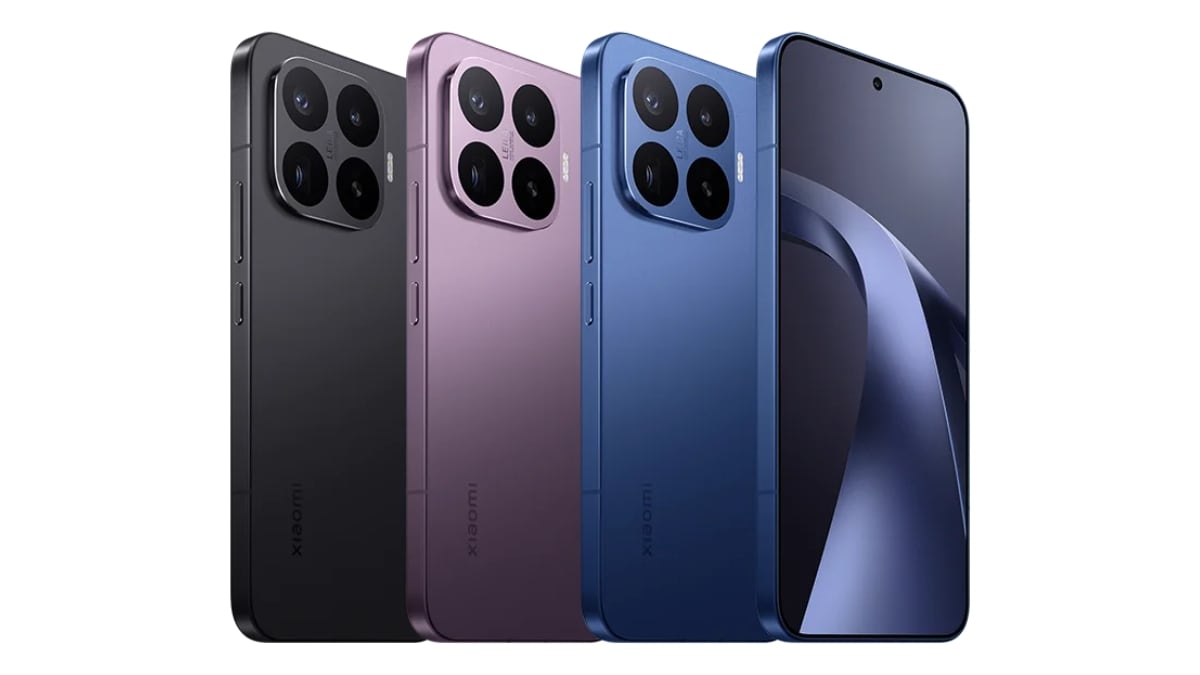
The Xiaomi 17T series was launched in the global markets on Thursday. The lineup, which succeeds the Xiaomi 15T series, comprises two models — Xiaomi 17T and Xiaomi 17T Pro. Both handsets are equipped with Leica-tuned triple rear camera systems. The MediaTek Dimensity 8500-Ultra SoC powers the former, while the latter gets the Dimensity 9500 chip. The Xiaomi 17T models sport 1.5K AMOLED screens and run on Android 16-based HyperOS 3.
Xiaomi 17T, Xiaomi 17T Pro Price, Availability
The price of the Xiaomi 17T starts at EUR 749 (roughly Rs. 83,500) for the base variant with 12GB of RAM and 256GB of onboard storage. The 512GB storage variant of the handset is priced at EUR 799 (roughly Rs. 89,000). It is available in four colourways — Black, Blue, Opal White, and Violet.
Meanwhile, the Xiaomi 17T Pro price is set at EUR 899 (roughly Rs. 1,02,000) for the 12GB + 512GB RAM and storage configuration. Its 512GB and 1TB storage variants are priced at EUR 999 (roughly Rs. 1,11,400) and EUR 1,099 (roughly Rs. 1,22,500). The handset is offered in Deep Blue, Deep Violet, and Black shades.
Both smartphones are currently on sale in the UK and select European markets.
Xiaomi 17T, Xiaomi 17T Pro Features, Specifications
The standard Xiaomi 17T sports a 6.59-inch AMOLED display with a 1.5K resolution, 120Hz refresh rate, HDR10+, Dolby Vision support, 100 percent DCI-P3 colour gamut coverage, and up to 3,500 nits peak brightness. The Xiaomi 17T Pro, on the other hand, comes with a larger 6.83-inch AMOLED display offering a refresh rate of up to 144Hz.
Under the hood, the 17T is powered by the MediaTek Dimensity 8500 Ultra chipset, paired with Xiaomi's Surge T1 Plus and T1S chips. The smartphone also features a 3D Ice Loop cooling system and support for Astro Communication, which Xiaomi claims can enable offline communication over distances of up to 1.3 kilometres in select situations. The Pro model, meanwhile, has the flagship MediaTek Dimensity 9500 SoC.
Both Xiaomi 17T handsets feature a Leica Complete Camera system comprising a 50-megapixel periscope telephoto camera with 5x optical zoom and a 12-megapixel ultra-wide-angle camera. The key difference lies in the primary camera. The 17T is equipped with a 50-megapixel Light Fusion 800 sensor, while the 17T Pro has a 50-megapixel Light Fusion 950 sensor, which is also used on the Xiaomi 17.
The Xiaomi 17T series also features a 32-megapixel front-facing camera and supports 4K HDR10 video recording at up to 60fps. The Xiaomi 17T and Xiaomi 17T Pro share several specifications, including Android 16-based HyperOS 3 and support for Xiaomi ecosystem features.
The Xiaomi 17T packs a 6,500mAh silicon-carbon battery with support for 67W wired fast charging. Battery capacity is slightly higher on the Pro model, coming in at 7,000mAh, with support for 100W wired fast charging and 50W wireless charging.
Comments
Post a Comment